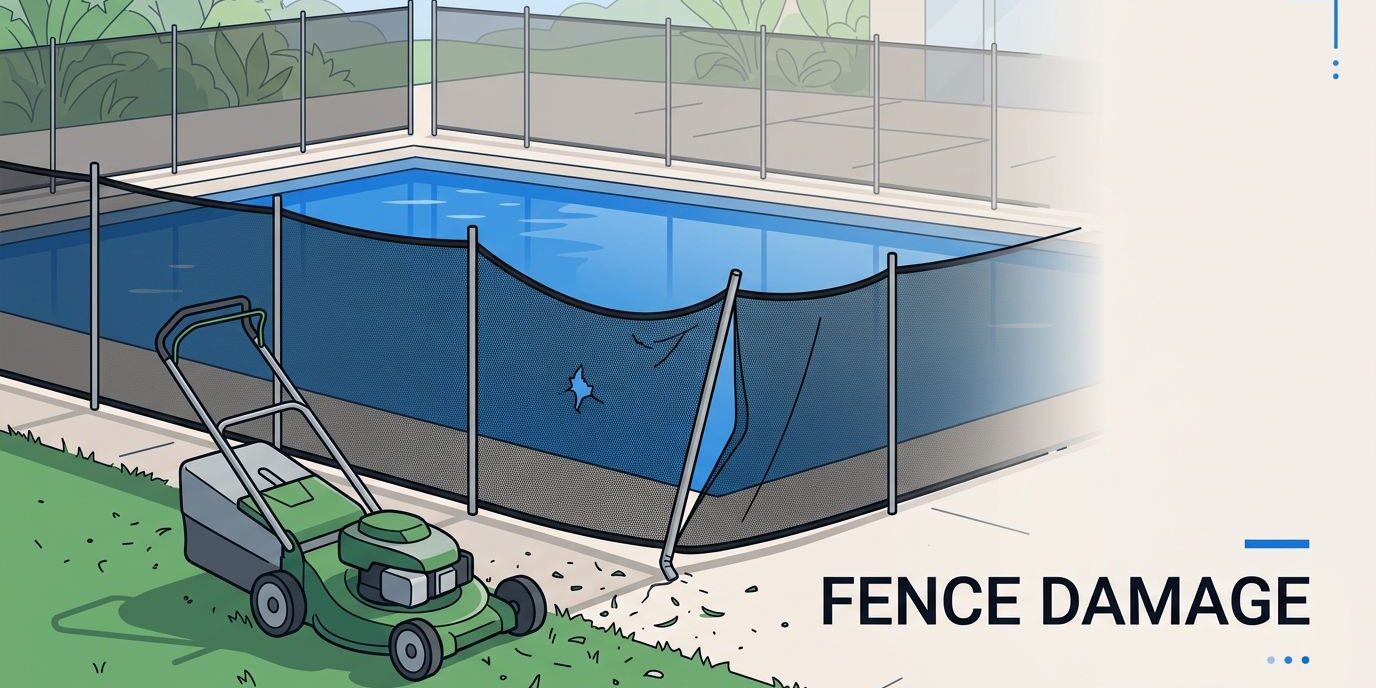
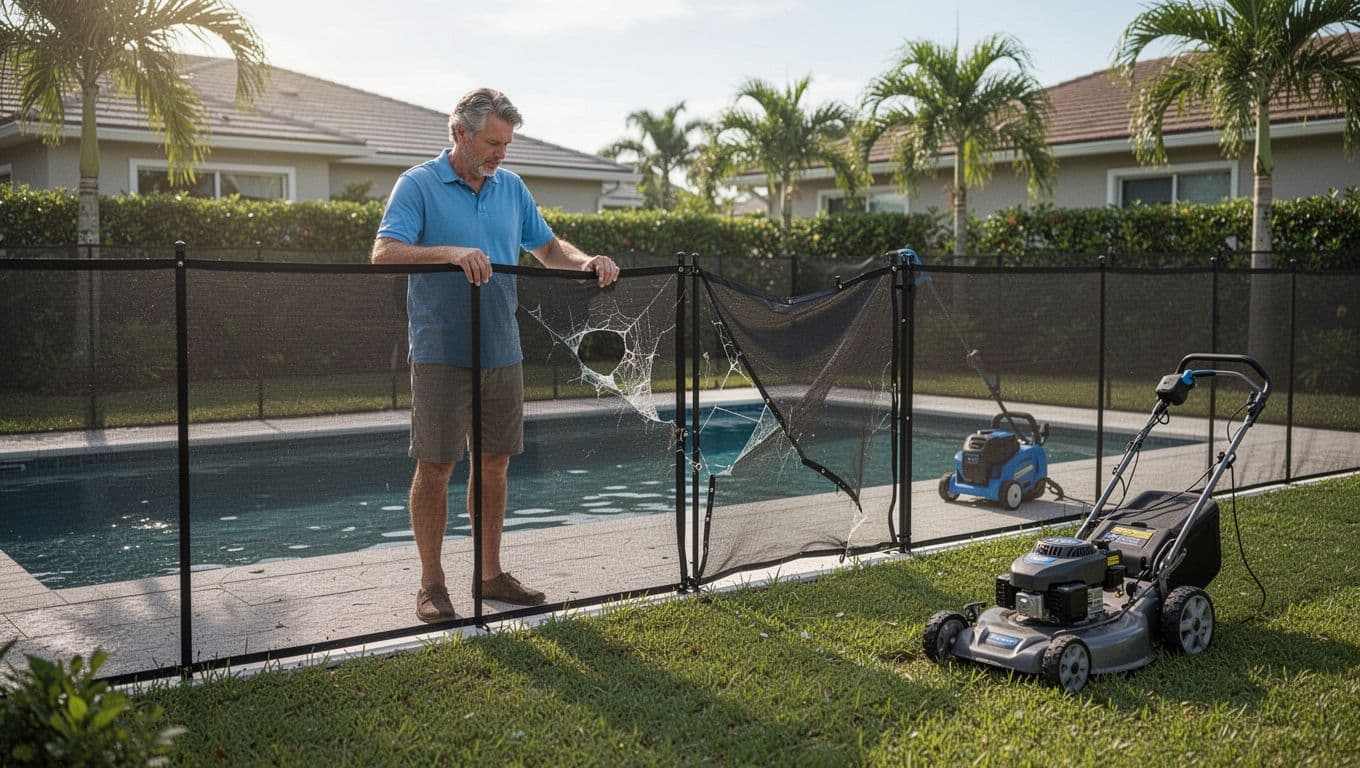
A mower can cause mesh pool barrier damage in seconds, even when the fence looked perfect that morning. Inspect it before the next swim.
Small tears, bent poles, and loose tension can weaken a mesh pool fence. As a pool safety fence, it helps protect the pool barrier and serve as a child safety barrier. Inspect it after mowing, trimming, or blowing leaves nearby.
Key Takeaways
- Lawn equipment can damage a mesh pool fence through flying debris, spinning trimmer line, direct contact, or strong blower airflow.
- Inspect the full pool safety barrier after mowing, trimming, storms, or accidental contact. Check the mesh, seams, tension, support poles, anchors, and self-closing, self-latching gate.
- A clean, isolated tear may allow a professional mesh repair, but widespread UV damage, sun-rot, structural sagging, bent poles, or seam damage often require full-section replacement.
- Keep mowers, trimmers, blowers, and other tools outside the debris path, and remove stones, sticks, toys, and mulch near the barrier before yard work.
- ASTM F2286 addresses barrier performance, but local building rules and manufacturer requirements also matter. Professional inspection can help confirm whether the repaired barrier remains safe and compliant.
How Lawn Equipment Causes Mesh Pool Barrier Damage
A removable mesh pool fence is strong, but it isn’t designed to absorb repeated hits from outdoor equipment. Polyester mesh with a polyvinyl coating handles normal weather well. Concentrated impacts can still exceed its tensile strength.
Even a compliant pool safety fence isn’t impact-proof. ASTM F2286 testing addresses barrier performance, not resistance to accidental lawn-equipment impact.
Sharp stones and spinning cords create concentrated force. That force can cut fibers, loosen a panel, or bend aluminum poles. The problem often starts with equipment placement, not the fence material itself. Check the warranty before assuming accidental equipment damage is covered; some policies exclude it.
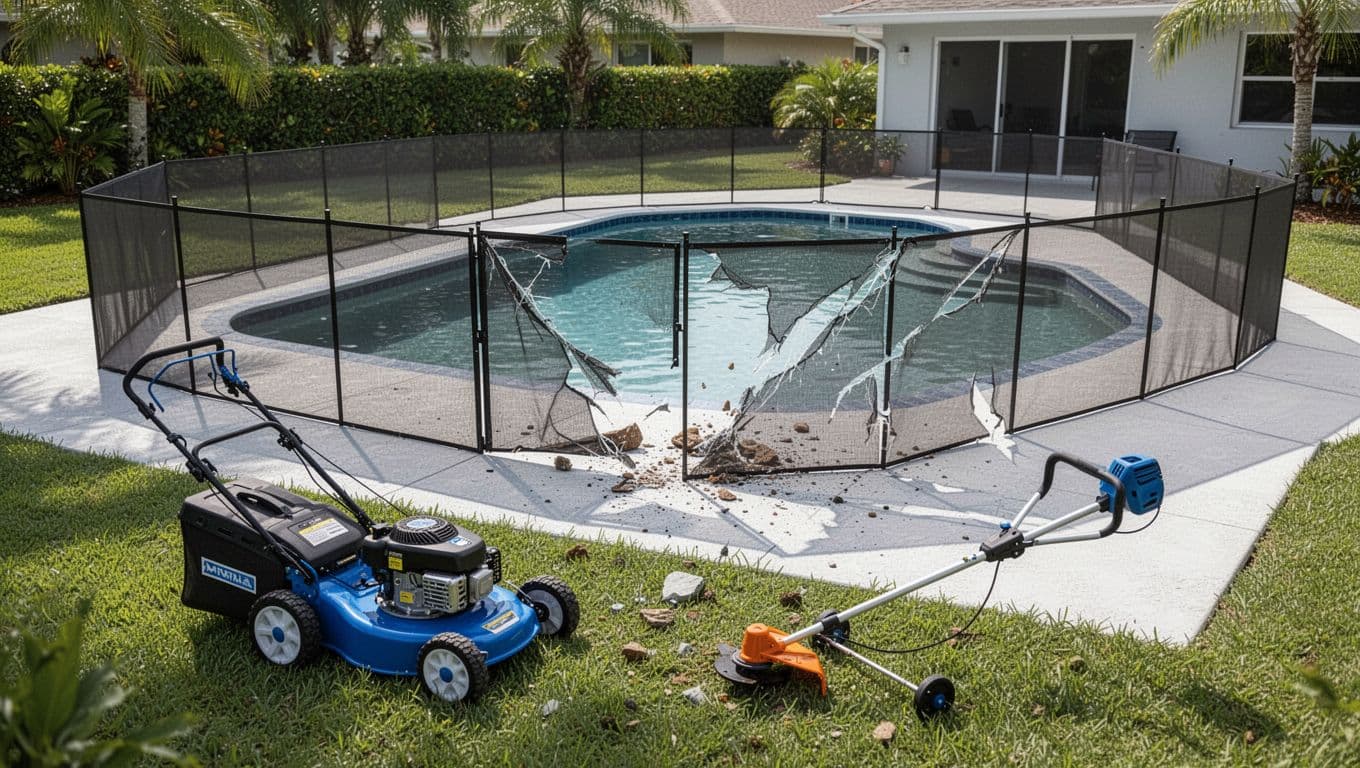
Mowers throw more than grass
Rotary mower blades can launch gravel, sticks, mulch, and other hard debris. Those pieces move quickly when a mower passes close to fence panels.
One stone may leave a pinhole, while repeated impacts enlarge the opening. Clippings can also stick to the mesh and hold moisture against the fabric.
Rear discharge can push debris toward the barrier, even when the mower never touches it. Keeping the machine several feet away gives flying debris room to fall.
A mower wheel can cause damage too. If it rolls over a lower panel or catches a support pole, the mesh may stretch suddenly.
Trimmers and blowers create different risks
String trimmers create a different problem. Rotating line can slice mesh when the operator edges grass beside a panel.
The line can also catch lower fabric and pull it away from the support poles. That pulling force may cause sagging, loose stitching, or loss of tension across the section.
Blowers add less cutting force, but strong airflow can drive gravel into weak spots. Loose stones near sleeves and anchors may strike the fabric repeatedly.
Edgers can kick up stones beside lower panels, while hedge trimmers can send clipped branches into the mesh. A pressure washer can damage the coating or drive grit into the fabric when aimed too close. Keep each tool pointed away from the fence.
Damage Homeowners Should Check After Yard Work
Not every damaged panel needs immediate replacement, but every change deserves a close look. An inspection works best before furniture, toys, or wet grass hide the lower edge.
Check the mesh, seams, and tension
Homeowners should walk the full perimeter of the mesh pool fence after mowing or trimming. They should check every part of the pool safety fence for holes, pulled stitching, fuzzy fibers, and cuts near the bottom.
In Southwest Florida, intense sunlight can speed UV degradation and sun-rot, leaving fibers brittle, faded, and less flexible.
Rain, salt air, pool chemicals, and regular handling add more wear. These conditions may weaken fabric before a homeowner notices a visible tear.
Each panel should stay firm without a deep belly between poles. A deep belly signals loss of tension and possible structural sagging.
Loss of tension can also begin after a pole or sleeve shifts, or a section screw loosens.
A light touch should not reveal a large gap below the fence. A gap or detached panel affects the complete barrier, even if the remaining sections look secure.
Photograph holes, pulled seams, loose poles, and gate gaps from close and wide angles. Record the date, location, and recent yard work for a potential warranty inquiry.
A fence can still look secure while a loose panel creates a gap or handhold. A child may use that opening to get through the pool safety barrier.
Inspect support poles, anchors, and the pool gate
A bent support pole changes the panel angle and reduces tension. A loose sleeve can also allow the pole to lean after repeated contact or ground movement.
Homeowners should check every pole for movement. The anchors should stay firm, and no panel should pull away from the deck.
The pool gate needs the same attention. It should swing shut on its own as a self-closing gate and latch without a push as a self-latching gate.
Misalignment can follow ground movement, settling, or temperature changes. Homeowners should test the latch twice, then check the gate gap.
Any gate that drags, stays open, or misses the latch needs service before pool use. Review local safety standards, too. The CPSC residential pool barrier guide provides guidance; ASTM F2286 and local code set separate requirements, so the references aren’t interchangeable.
Repair or Replace a Damaged Mesh Section?
Quick action can save a full panel on a mesh pool fence. A patch cannot restore strength once UV degradation or sun-rot has weakened surrounding fibers.
When a small repair may work
A clean, isolated tear may let a technician repair damage with a mesh repair kit. The surrounding polyester mesh must remain flexible, firmly attached, and free from additional damage.
Mesh replacement for an isolated section often uses standard 15-foot sections. Repair work still requires accurate cutting, matching holes, and even tension.
DIY repairs can create inaccurate cuts, misaligned holes, or uneven tension. Review the kit or material warranty before proceeding, since DIY work may affect eligibility.
Some installers use the foot-bowing method to pull the mesh tight before securing section screws. This can correct loss of tension before structural sagging develops.
An uneven repair can leave wrinkles, gaps, or stress near the next pole. The damaged section may then fail again after wind or regular handling.
Homeowners should stop using the barrier if a tear reaches a seam or support point. Those areas carry more load and often need a full-section replacement.
A temporary patch should never delay professional inspection or be represented as restoring ASTM F2286 compliance. Pool safety depends on the complete barrier, not one repaired spot.
When full-section replacement makes more sense
Full mesh replacement makes more sense when fabric shows widespread UV damage, several tears, loss of tension, or deep structural sagging. Bent aluminum poles also need correction before new mesh goes in.
Replacing fabric without fixing the anchor leaves the same weakness underneath. A reliable repair checks the deck sleeves, pole spacing, panel tension, and gate alignment together.
Homeowners comparing mesh with glass should weigh repairability as well. A glass pool fence usually needs panel replacement after impact, while mesh may allow an isolated section repair. Anchor and gate work can be more hardware-specific with a glass pool fence, while mesh repairs focus on poles, sleeves, and tension. A glass pool fence also depends on compatibility with the surrounding deck. Long-term maintenance differs too, because a glass pool fence needs regular cleaning, while mesh needs fabric and tension checks.
Replacement fabric may have separate warranty coverage, but terms vary by product.
These choices matter across concrete, pavers, brick, artificial turf, and other deck surface materials. Each material can affect anchor stability and installation work.
A local installer can inspect the barrier and explain repair options clearly. Professional installation is advisable when anchors, poles, or gates need correction.
Ask whether workmanship warranty terms cover that work. Homeowners in Southwest Florida can schedule a pool fence installation estimate. Ask how the pool fence cost is calculated, including whether pricing uses a linear foot rate.
Safer Lawn Care Around a Pool Safety Fence
Most lawn equipment damage is preventable with one simple rule: keep moving tools outside the debris path around the pool barrier.
Change the mowing and trimming route
Before mowing, workers should remove stones, sticks, toys, and loose mulch near the perimeter of a mesh pool fence. Mowing should direct discharge away from the mesh.
A hand tool works better for the narrow strip beside the fence. It gives the operator more control and avoids forcing a mower deck close to support poles.
Trimmers should stay upright and away from panel edges. The spinning line should never touch the lower fabric.
Blowers should point across the lawn, never directly at the mesh. Strong airflow can move gravel, clippings, and dry branches toward the barrier.
Workers should move furniture and toys before equipment enters the yard. If a landscaper handles the property, the homeowner should explain the fence boundary first.
A small conversation can prevent an expensive repair. It also keeps the pool area safer for children, grandparents, pets, and visiting caregivers.
Clean and inspect the fence regularly
These maintenance steps help reveal wear before it becomes a major problem. Homeowners can rinse mesh with fresh water and use mild soap on stubborn dirt.
Harsh solvents, abrasive brushes, and high-pressure spray can weaken or distort fabric. A soft brush works better around dusty lower edges and support points.
After cleaning, the barrier should dry before removable mesh gets rolled or stored. Wet storage can encourage mildew and leave the fabric smelling unpleasant.
When a warranty applies, follow the manufacturer’s cleaning and storage directions.
Removable sections need a dry, protected storage area when the pool deck changes. They should not rest under heavy tools, furniture, or sharp yard debris.
A monthly inspection works well for many homes. Look for UV degradation, including faded mesh or brittle fibers.
Another check should follow storms, major yard work, or any accidental contact. Check for sun-rot at exposed edges, loss of tension in loose mesh, and structural sagging between supports.
Salt, sun, and wet debris deserve extra attention near coastal homes. Routine maintenance supports ASTM F2286 compliance, but it doesn’t replace periodic gate and barrier checks.
These simple checks help keep the barrier dependable and support pool security. They also give homeowners time to call for help before a panel fails.
Safety Standards and Pool Fence Costs
A fence can look tidy and still fail a safety check. Repairs must protect the barrier’s function, not only its appearance.
What ASTM F2286 means
ASTM F2286 sets design and performance requirements for removable mesh safety barriers. It covers barrier height, openings, strength, and gate performance.
ASTM F2286 is a standard, not a replacement for local building rules. Manufacturer certification language can also vary, so homeowners should request product information.
The purpose of a pool safety barrier is to restrict access and support pool security, not merely create a visual boundary.
The ASTM F2286 barrier guideline describes a bottom gap of no more than one inch above the deck.
ASTM F2286 also addresses barrier height and openings. Many residential guidelines call for a barrier at least 48 inches high, but local requirements can vary.
The pool barrier inspection guidance from InterNACHI also discusses height, openings, and gate placement. Local authorities and qualified installers should confirm the rules before installation or repair.
A visibly patched panel may still require inspection under ASTM F2286, even when the gate works. Homeowners shouldn’t rely on a visual patch alone.
How mesh compares with a glass pool fence
Removable mesh and glass systems solve the same access problem, but they differ in cost, upkeep, and repair options.
Upfront pricing usually favors a mesh system over a glass pool fence, but the purchase price isn’t the only factor.
A mesh pool fence often costs about $15 to $35 per linear foot. A glass pool fence commonly costs about $150 to $800 per linear foot.
Your pool fence cost depends on access, deck surface, gate design, labor, and the extent of damage. During pool fence installation, a glass pool fence may require more careful delivery and handling.
Professional installation is especially valuable when access is narrow or the deck needs reinforcement.
Deck compatibility matters as well. A glass pool fence needs stable anchors and a suitable support system.
Impact and repairability differ too. A cracked glass pool fence usually needs a full panel or hardware repair.
A small mesh replacement may cost less than replacing an entire barrier system. A glass pool fence may require specialized replacement glass after a serious impact.
Mesh sections can be repaired individually, but structural sagging may signal broader failure.
Cleaning a glass pool fence is simple, though fingerprints and water spots remain visible.
A glass pool fence generally resists UV degradation, but its seals and hardware still need care.
Age matters, too. A bright replacement section may look uneven beside mesh with widespread sun-rot.
For visibility, a glass pool fence preserves an open sightline across the deck.
Gate configuration also affects daily use. A glass pool fence can accommodate a self-latching gate with carefully aligned hardware.
Compliance depends on the complete system, not just the panel material. A glass pool fence must still meet local height, opening, and gate rules.
Coverage details deserve separate review. The glass pool fence warranty may cover manufacturer material defects.
A separate glass product warranty may address defects in the panels or hardware. An installation workmanship warranty covers fitting errors.
Warranty exclusions may include accidental impact or improper maintenance.
Lifespan varies with climate, upkeep, hardware quality, and impact history. A glass pool fence may retain its appearance longer, but damaged mesh can be more economical to renew.
The right choice depends on the barrier’s overall condition, access, and maintenance expectations. Choose a glass pool fence when visibility and a permanent-looking design are priorities.
Frequently Asked Questions
Can a mower damage a mesh pool fence without touching it?
Yes. A mower can throw stones, sticks, mulch, and other debris into the mesh at high speed, creating pinholes, cuts, or loose stitching. Rear discharge can increase the risk when the mower operates close to the barrier.
What should I check after using lawn equipment near the fence?
Inspect every panel for holes, pulled seams, fuzzy fibers, loss of tension, and gaps near the deck. Also check support poles, anchors, sleeves, and the pool gate to confirm that it closes and latches completely.
Can a small tear in a mesh pool fence be repaired?
A clean, isolated tear may be repairable when the surrounding mesh remains flexible and firmly attached. Damage near a seam or support point, widespread UV degradation, or structural sagging may require full-section replacement and professional inspection.
How can I prevent lawn equipment damage to the pool barrier?
Keep moving tools outside the debris path and direct mower discharge and blower airflow away from the mesh. Use a hand tool beside narrow fence strips, keep trimmer line away from the lower fabric, and remove loose stones and yard debris before starting work.
Conclusion
Grass, stones, and spinning trimmer line can damage a mesh pool fence quickly. UV exposure, loose hardware, ground shift, and poor tension can weaken a pool safety fence further.
Move equipment away, inspect every panel, and check the pool gate for complete closure and latch function. Follow these maintenance steps, and repair damage such as tears, bent poles, or loose anchors promptly.
Southwest Florida homeowners who need a professional review can Get a FREE Pool Fence Installation Quote. A quick inspection can restore comfort and peace of mind, while a glass pool fence offers another replacement option.