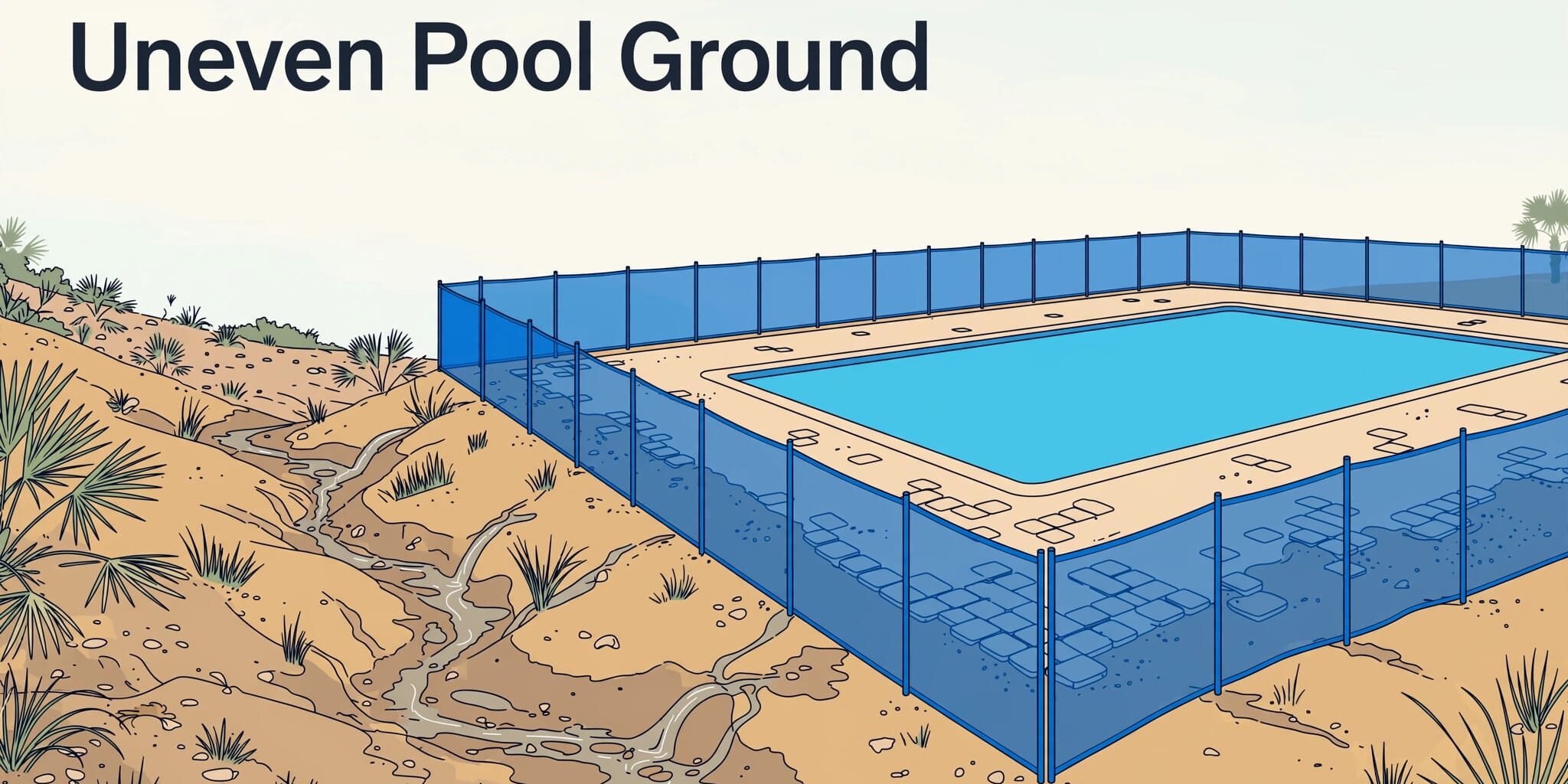
In Southwest Florida, pool barrier installation requires more than a straight line of fence sections. Wet-season runoff, settling soil, sandy grade changes, loose pavers, and sloped pool decks can all affect the layout.
A removable pool fence with mesh panels can adapt to an uneven in-ground pool area and still work properly. As a low-profile pool safety fence, it can support a broader pool enclosure plan without promising to enclose the entire yard. This mesh pool fence approach starts with a ground check, one of the most practical pool safety tips for controlling access.
An above ground pool may involve different access points, ladder use, and barrier considerations. Confirm those details with the local authority, then follow pool safety tips for controlled entry after heavy rain. Swimming pool safety also depends on a stable surface.
Key Takeaways
- Inspect the full pool perimeter from both the pool and yard sides before drilling, paying attention to slopes, low spots, drainage paths, loose pavers, sandy soil, and settling.
- Florida requirements set minimum standards for barrier height, openings, bottom gaps, climbable objects, and gate operation. Confirm current state, county, and city requirements before starting work.
- Gradual slopes may allow sections to follow the grade, while sharper changes usually need stepped sections to maintain mesh tension and control the lower edge.
- Use the correct drilling method and product spacing for the deck surface, then test the posts, mesh, lower edge, gate, and latch after installation, storms, landscaping work, or fence removal.
Why Uneven Ground Changes Pool Barrier Installation
Slopes, low spots, and rushed layouts can create bottom gaps, leaning sections, and gate problems. A pool safety fence should be assessed from the deck and yard side, because even a small low spot can leave room beneath it.
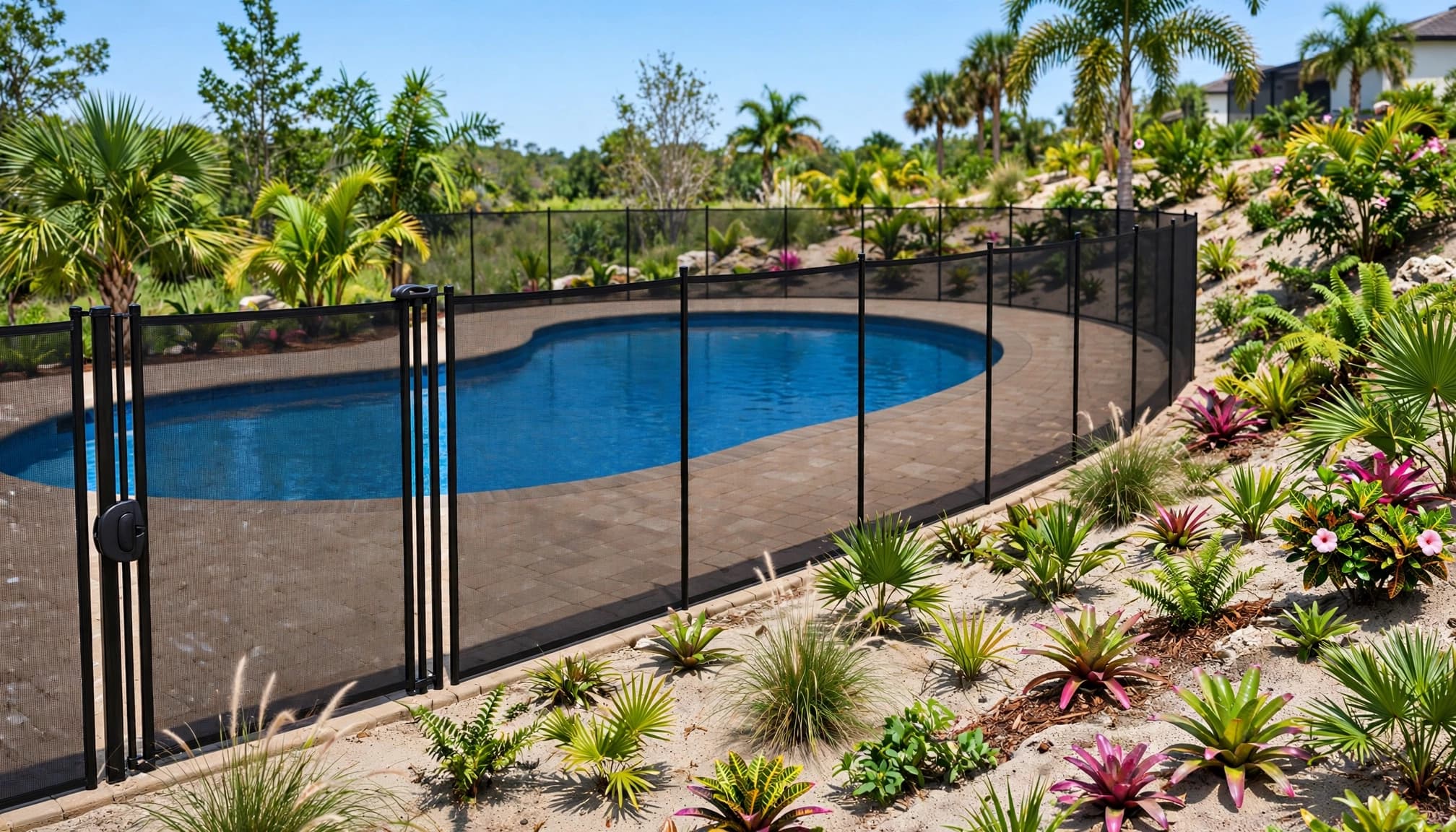
A properly fitted pool safety fence follows the pool area’s shape without looking crooked or leaving weak points. Each post needs a stable position, and a mesh pool fence should preserve visibility while maintaining even tension around curves.
Check the deck and the surrounding grade first
Installers should walk the full pool perimeter before marking holes, including the yard side. This swimming pool safety check should identify cracked concrete, loose pavers, washed-out mulch, soft soil, and drainage paths.
A post can loosen beside shifting pavers or a sandy edge. One of the most useful pool safety tips is checking whether pavers rock underfoot, then re-leveling them before the fence goes in.
An above ground pool has different access points, so don’t automatically assess it using the same perimeter assumptions as an in-ground pool.
Pool equipment, planters, furniture, and low landscape walls also matter because they can create climbing routes. For swimming pool safety, clear climbable objects and check these features from the yard side.
Keep the barrier close enough to control access
Many homeowners place a removable mesh fence about 24 inches from the water’s edge, leaving room for cleaning and pool use.
However, distance depends on the deck shape, gate location, and available walking room. Practical pool safety tips include checking the lower edge from the yard side before accepting the layout.
A barrier needs to block easy access from the home and yard while still allowing room for cleaning and pool use.
A fence can look straight from the patio and still leave a dangerous bottom gap, so ground-level viewing belongs among the most important pool safety tips.
Florida Pool Barrier Rules Set the Minimum
A pool barrier is more than a backyard improvement. It is a safety feature that must follow Florida’s safety barrier guidelines and applicable local requirements.
These barrier guidelines set a minimum, not a substitute for site-specific review. Before work begins, verify the current Florida statute, applicable Florida Building Code provisions, and requirements from the relevant city or county authority. The 2026 Florida pool safety statutes cover residential pool safety features, barriers, and child drowning prevention, but homeowners should confirm the current version and interpretation.
Requirements in Lee, Collier, and Charlotte counties may differ in permitting, inspection, barrier placement, and required documentation under local building codes. Confirming these details is one of the most useful pool safety tips before work starts.
Barrier height, gaps, and climbable objects
Florida’s residential barrier law requires a pool safety fence at least 48 inches high on the outside. On uneven ground, verify how the authority measures height along the finished grade. Maintaining the required height is a basic pool safety tip for swimming pool safety.
The Florida residential barrier requirements explain that the pool safety fence must fully surround the pool area. They also limit openings and bottom gaps that could allow a child to pass through.
Checking these dimensions is an important pool safety tip for swimming pool safety, particularly where the ground slopes. Uneven ground makes bottom clearance harder to control. The fence line may need adjusted post locations or stepped sections to keep clearance consistent.
A pool safety fence should never sit beside furniture, storage bins, pumps, or landscape features that invite climbing. Removing climbable objects is another pool safety tip for swimming pool safety.
An above ground pool can require a different compliance analysis. Its walls, ladders, and access points may affect barrier placement and inspection requirements.
Gates need extra attention
The gate is the part families use most. It also needs to close and latch every single time.
Where applicable, a compliant gate should swing away from the pool, close by itself, and latch by itself. Proper gate installation confirms that the self-closing gate and latch operate from every position.
The pool gate latch and release hardware need placement that young children can’t easily reach. A latch may drift out of alignment after fence removal, storms, or normal use.
Homeowners should test the gate after every reinstallation, a pool safety tip that supports swimming pool safety.
Florida’s Chapter 64E-9 applies to public pools, not most private home pools. Older documents may mention the BOCA pool code, but that legacy reference isn’t a substitute for current Florida or local requirements.
The Florida Department of Health pool guidance offers useful context for pool safety standards and access control at public pools. Homeowners should follow the residential statute and local review process instead.
Start With a Clear Layout and Grade Plan
A clear layout for a pool safety fence starts at the pool edge. Measure the route, mark curves and corners, and check it from both sides before drilling. The approved route should guide pool fence installation, rather than having drilling lead the plan.
Mark drainage paths, planting beds, raised edges, and areas where soil may settle. Plan around those changes now, so future soil settlement doesn’t create a gap. This helps a removable pool fence come down and go back in without losing planned post positions.
Some systems use about 30 inches between poles, but product instructions control pole spacing. Curves, steps, and grade changes may require tighter spacing.
Identify the required drilling method before finalizing post locations. A diamond core drill may be needed for some deck surfaces.
An above ground pool needs its own route plan. Account for the pool wall, ladder, deck, and access point instead of copying a ground-level layout.
Mark every change in elevation
A string line or chalk line helps reveal where the surface rises or falls. Mark post locations before bringing out the drill.
On a gradual slope, sections can follow the grade with carefully set posts. Use these pool safety tips to keep the lower edge controlled. This supports swimming pool safety without forcing the top line level.
On a sharper drop, good pool safety tips call for a stepped layout. Each section should preserve a controlled lower edge, not merely follow the top horizon.
The top line doesn’t have to follow the horizon perfectly. It does need to look clean while maintaining proper tension and coverage.
Don’t force a straight fence across bad ground
Trying to pull one panel across a low area can create a gap. Pulling it too tight can strain the mesh and posts.
Instead, installers can adjust the layout around a planting bed, deck corner, or raised edge. These pool safety tips also mean checking low points and drainage paths before accepting one long section.
The pool safety fence should create a complete protected zone, not chase a perfect rectangle. This supports swimming pool safety across changing grades.
A clear plan keeps the gate on the most level, practical path. Keep pool safety tips in mind when choosing its route. That supports swimming pool safety and helps the gate close without fighting the slope.
Mesh, Posts, and Drilling Methods Matter
Not all removable mesh fences have the same feel, visibility, or strength. Homeowners should ask which mesh, post system, and gate hardware the company uses.
Quality materials matter in Southwest Florida. Pool safety tips begin with choosing products that can handle UV exposure, humidity, rain, and chlorinated water. For swimming pool safety, review the manufacturer’s care and performance information.
Choose mesh for visibility and protection
A quality pool safety fence should balance visibility, coverage, and the needs of the household.
A 100-hole mesh has a tighter weave than a 25-hole style. It can offer more privacy and limit the visibility of small items, but mesh count alone doesn’t determine protection. Practical pool safety tips include comparing the product’s visibility with the yard’s sightlines.
A 25-hole mesh usually gives a more open backyard view. Both styles can work well when the product fits the home’s needs and is installed as intended. Good pool safety tips also include checking the manufacturer’s documentation. If it identifies the model as ASTM certified, verify that claim for the exact product.
The right choice often comes down to children, pets, sightlines, and personal preference. For swimming pool safety, the fence should feel like a natural part of the pool area, not a bulky obstacle.
Use the right drill for the surface
Concrete decks need clean, accurate holes for removable fence sleeves. A diamond core drill can create a controlled opening with less chipping when appropriate. Before drilling, the installer must assess slab condition, edge distances, utilities, and sleeve locations.
A hammer drill can chip concrete, crack pavers, or leave a rough opening. That damage becomes more likely near deck edges or on older surfaces. Pool safety tips also include avoiding cracked or unstable deck areas.
Travertine and paver decks need even more care. Existing construction affects deck installation and drilling locations. An installer should inspect every drilling point before work begins, especially where uneven pavers may shift.
How Professionals Handle Slopes and Paver Decks
A professional installer does not treat every backyard the same. Pool shapes, lanai exits, deck materials, landscape borders, and drainage paths all change the work.
Sandy areas that may settle after heavy rain need special attention. For an above ground pool, the assessment must also account for the pool wall, ladder, and access equipment.
That careful approach matters when a family wants a pool safety fence without giving up the view. A well-installed mesh pool fence stays low-profile and looks clean.

Stepped sections keep bottom gaps controlled
A stepped pool safety fence uses separate sections to follow a sharper change in elevation. A gradual grade may allow a fence to follow the slope, but not every slope suits one continuous panel.
Pole spacing and section length must follow the product design and the site’s actual grade. Each panel stays properly tensioned instead of sagging across a dip.
This approach works well beside raised planters, split-level patios, and deck-to-yard transitions. It also helps protect the lower edge around sandy areas that may settle after heavy rain.
Keep soil, mulch, and irrigation runoff from washing out the lower edge or loosening sleeves. Protecting drainage paths is one of the most practical pool safety tips for sloped yards.
The installer should check the full fence from both sides after setup. One of the most important pool safety tips is looking for gaps from the yard side.
A section that appears secure poolside may still show a gap from the yard side, which can compromise swimming pool safety.
Clear communication prevents bad surprises
Homeowners deserve to know where posts will go and how the gate will operate. The gate installation should use the most level, practical route through the yard.
A good installer explains any problem areas before drilling begins. That includes loose pavers, drainage concerns, narrow deck space, root growth, or a gate location that needs adjustment.
Reviewing these landscape conflicts is one of the most useful pool safety tips before work begins. Quick answers and clear expectations make the project feel easy.
A site visit also gives the homeowner a chance to ask about fence height, mesh color, removable sections, and gate placement. Those details should never feel rushed.
Confirming gate operation is one of the final pool safety tips and supports swimming pool safety.
DIY Pool Fence or Professional Installation?
A handy homeowner may install a removable pool fence on a level concrete deck. However, a level layout still needs careful planning for a pool safety fence.
One poorly placed hole can damage a deck. One unaddressed low spot can create an unsafe bottom gap. Uneven ground, pavers, curves, drainage, soft soil, and gate alignment increase that risk.
DIY may work on simple, level layouts
A straightforward deck with solid concrete and no grade changes is easier to measure. Pool fence installation still requires accurate tools, proper sleeves, and dependable gate hardware.
A diamond core drill may suit some concrete decks. Before drilling, confirm slab thickness, embedded utilities, edge distances, and the correct sleeve system.
The fence should receive a full safety check after installation, one of the most useful pool safety tips. For swimming pool safety, use these pool safety tips to check every post, lower edge, and tension point. Other pool safety tips include reviewing the gate installation and hardware; further pool safety tips call for testing closure after rain to support swimming pool safety.
DIY work gets more difficult around curves, slopes, soft ground, pavers, and landscape borders. An above ground pool also requires separate evaluation because its access system may change the barrier route.
Professional installation brings practical peace of mind
Professional crews inspect the deck, map the layout, and adjust the barrier around real conditions. They know where a clean post location is possible and where it is not.
Homeowners who want a custom plan can schedule a pool safety fence consultation. A site-specific estimate can address slopes, gate placement, and the best barrier route.
Professional help doesn’t replace checking current local requirements before work begins. For a fast starting point, homeowners can also Get a FREE Quote. A clear quote makes it easier to plan safety improvements without guessing.
Maintain the Fence After Storm Season
A pool safety fence needs occasional checks, especially during Southwest Florida’s storm season. Heavy rain, wind, and regular pool activity can shift soil, loosen sleeves, and affect mesh tension, lower-edge clearance, or gate alignment.
Homeowners should inspect a removable pool fence after major storms, deck repairs, landscaping changes, or removal and reinstallation. Repeated removal can loosen sleeves or change pole alignment. After a storm, following these pool safety tips takes only a few minutes and supports swimming pool safety.
Use a simple safety check
Use these pool safety tips to inspect the pool safety fence and maintain swimming pool safety:
- For gate checks, the key pool safety tips are simple. Test the gate until it closes and latches without help, then confirm the pool gate latch holds securely.
- At the lower edge, pool safety tips include looking for gaps below the mesh, especially near slopes, mulch beds, or washed-out soil.
- For posts, reliable pool safety tips start with checking that every pole feels secure and confirming the planned pole spacing remains unchanged.
- Climbable-object pool safety tips include moving furniture, toys, and planters away from the barrier.
- Drainage pool safety tips include watching for deck settling, loose pavers, or soil washout near posts.
- After reinstallation, use pool safety tips to retest mesh tension, sleeve stability, lower-edge clearance, and gate alignment.
Repairs, alterations, or pool changes may require review under local building codes. The Florida Building Code barrier reference also shows how details like opening size, gate hardware, and barrier strength fit together.
Frequently Asked Questions
What type of pool barrier works best on uneven ground?
A removable mesh pool fence can work well when the layout follows the actual grade. Gradual slopes may use sections that follow the ground, while sharper changes may require stepped sections to control bottom gaps.
How far should a pool fence be from the water?
Many homeowners place a removable mesh fence about 24 inches from the water’s edge, but the correct distance depends on the deck, gate route, and available walking space. Check the lower edge from the yard side and confirm the layout meets local requirements.
What Florida requirements apply to a residential pool barrier?
Florida’s residential requirements generally include a barrier at least 48 inches high on the outside, controlled openings and bottom gaps, no nearby climbable objects, and a properly operating gate. Confirm the current statute, Florida Building Code provisions, and city or county requirements before installation.
Can I install a pool fence myself on uneven ground?
DIY installation may be reasonable on a simple, level concrete deck with no major grade changes. Slopes, curves, pavers, soft soil, drainage issues, and gate alignment make professional installation a safer choice.
What should I check after a storm?
Inspect the lower edge for gaps, confirm that posts and sleeves remain secure, and check mesh tension and drainage near the barrier. Test the gate so it closes and latches by itself, and repeat the inspection after landscaping work or fence removal.
A Safer Pool Area Starts With the Ground
Uneven ground doesn’t stop a family from adding a dependable pool barrier. Sloped, stepped, paver, and sandy conditions simply require a more careful plan.
A thoughtful pool barrier installation coordinates the fence route, lower edge, drainage, post locations, and gate. That detail creates a dependable pool safety fence and supports everyday swimming pool safety.
Use these pool safety tips when checking the lower edge, gate, and drainage after storms. Simple pool safety tips also include watching for shifting sand, pavers, or soil.
Questions or ready to get started? Call us at (941) 500-9484