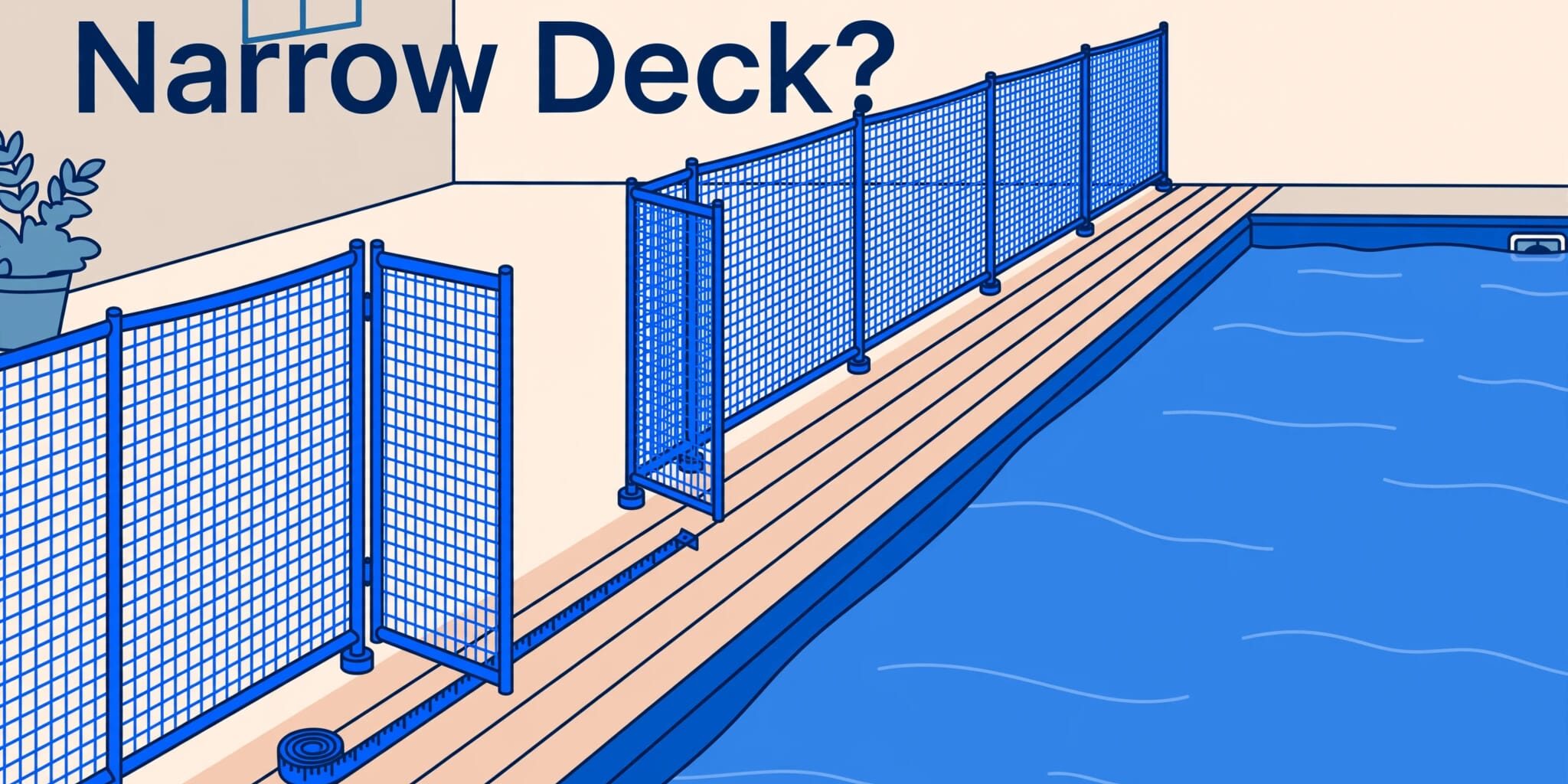
A removable pool fence may fit a narrow deck, but clearance, anchor locations, and gate swing determine whether it works. A removable mesh pool fence with sleeve-mounted anchors can preserve walking space, but measurements determine suitability.
That’s good news for families who want clear pool views without crowding the patio. Plan the full layout, including the walkway and gate, before choosing a fence system.
Key Takeaways
- Sleeve-mounted mesh usually leaves more walking room.
- No-drill bases avoid holes but require more deck space.
- Gate clearance, secure anchoring, and local barrier rules determine whether the layout works.
Plan the Removable Pool Fence Around the Tightest Spot
Leave room beside the water
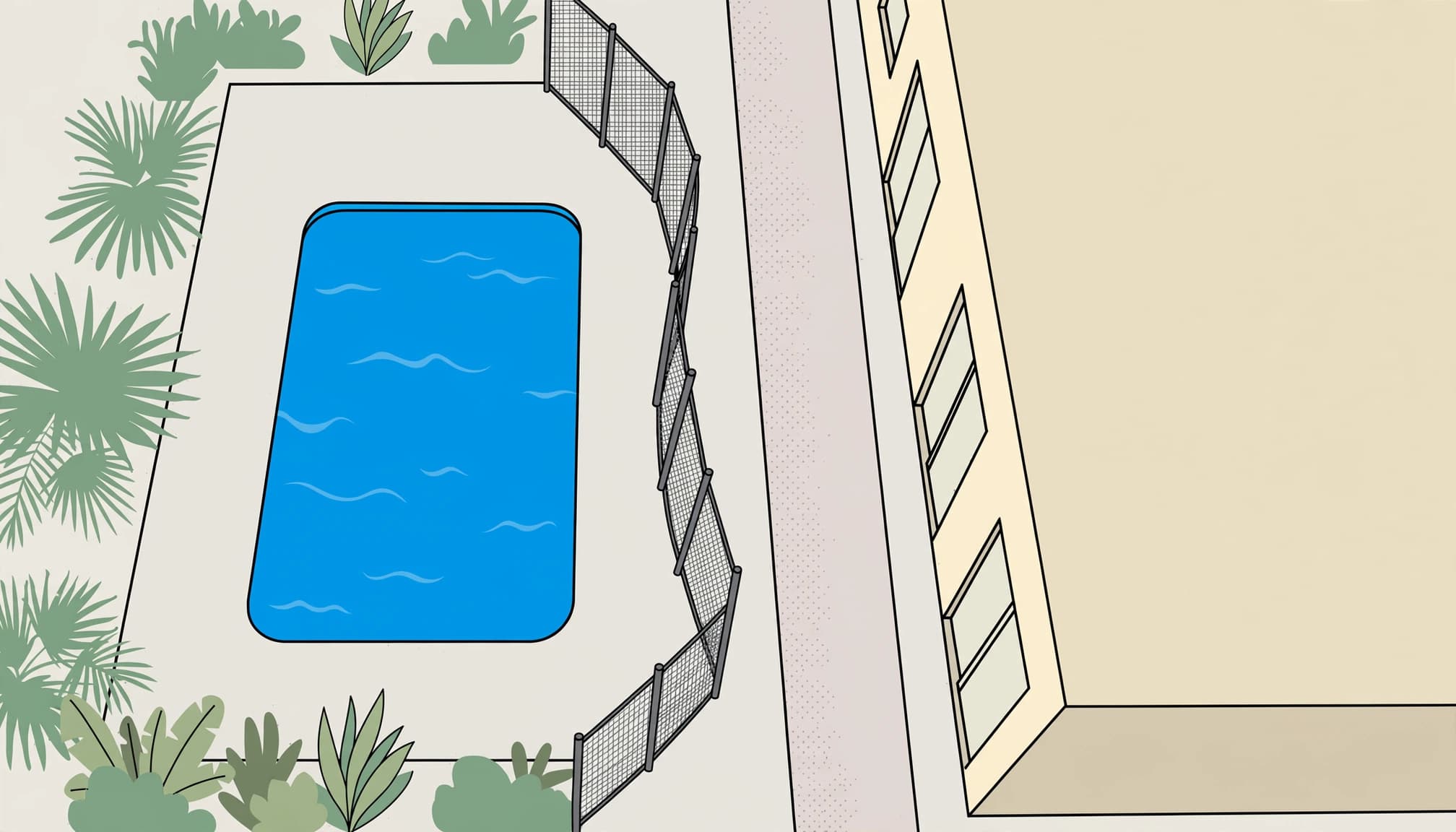
Measure the tightest clearance before choosing anchor positions. A common planning target places sleeves at least 20 inches from the water’s edge. Less than 18 inches leaves cramped working space. These measurements are planning guidance, not universal code setbacks.
Installers also measure drains, steps, raised walls, and screen tracks. Check the usable walkway and route the barrier around these features without leaving convenient gaps. Furniture and planters belong away from the mesh.
Give the gate enough clearance
An outward-swinging pool gate needs a clear swing and landing area, even when the fence panels fit. Measure the full swing and landing area, and check that chairs, walls, and screen doors won’t block it.
Curved decks may need shorter sections and adjusted pole spacing. A pool fence installation consultation helps establish the route before drilling.
Compare Drilled Sleeves With No-Drill Bases
Sleeve-mounted systems use little deck space, but they need suitable anchor locations. Water-filled bases avoid deck holes with no drilling, but they still need room and a suitable surface.
These figures provide an early planning comparison.
| System | Cost per linear foot | Narrow-deck consideration |
|---|---|---|
| Standard sleeve-mounted mesh | About $17 to $35 installed | Compact anchors preserve space |
| Water-filled no-drill bases | System-dependent pricing | Bases occupy additional deck space |
For an early pool fence cost estimate, 100 feet at this mesh-fence range costs about $1,700 to $3,500 before custom work. Specialty gates and difficult surfaces can increase the total.
Guardian’s No Holes system uses high-density polyethylene bases. Each holds about eight gallons of water and weighs roughly 65 pounds when filled. A 12-foot section weighs about 260 pounds.
That ballast supports the system, but weight alone doesn’t establish code compliance. No-drill doesn’t mean the system suits every surface.
Renters need landlord permission for the proposed installation. Empty the bases before moving them, then store them with their compatible panels and hardware.
Choose Mesh, Poles, and Connections Together
Strong mesh needs proper tension
Standard pole spacing commonly measures 36 inches, although systems vary. Closer spacing can support tension and strength when the manufacturer’s design allows it.
Basket-woven polyester mesh with a vinyl coating resists mildew and punctures. Vinyl borders on all four sides help prevent fraying.
Guardian’s Premier options include Guardlock, with 5-by-5 strands per square inch, and Guardtex, with 10-by-10. Its Pet Mesh uses an 11-by-16 pattern. Strand counts alone don’t establish overall barrier performance.
Check whether the system you choose uses aluminum poles and stainless steel hardware. Materials vary by product.
Keep brand claims in perspective
Life Saver advertises tensile strength above 387 pounds per square inch. The company also advertises a 100-year warranty covering every fence part, but that doesn’t automatically make it a lifetime warranty. Check the written warranty terms.
Its roughly 15-foot sections weigh about 16 pounds each. The company advertises that one person can remove a 100-foot fence in under 15 minutes.
Some systems secure adjoining panels with padlocks. Guardian’s no-drill guidance calls for approximately 10 to 15 padlocks for an average fence. The chosen system’s connections matter as much as its fabric.
How Installation Works on a Tight Deck
For removable pool fence installation on a narrow deck, first check walking clearance and whether the surface can support the selected anchors. These installation steps also account for drains, deck edges, and gate swing.
- Measure the complete barrier route, including walking clearance, gate swing, curves, drainage, and access points. Confirm sound support beneath every planned anchor.
- Mark mounting sleeves according to the selected system. Where specified, use a hammer drill with a 1-1/8-inch masonry bit.
- For that method, hold the drill vertically and drill four inches deep. Set each deck sleeve flush with the deck.
- For no-drill systems, position the bases, connect the panels, and fill the bases according to the manufacturer’s instructions.
- Tension the mesh, secure every connection, and test the gate repeatedly.
The 1-1/8-inch bit and four-inch depth apply only to that method. Check the system instructions before you drill the holes. Tools, depths, and anchoring designs vary by surface and fence system. Cracked concrete, loose pavers, and tight drain locations deserve professional assessment.
Height, Gaps, and Gate Rules Still Apply
A suitable pool safety fence must meet applicable safety requirements, including minimum fence height. Available heights include 48 inches (four feet) and 54 inches (4.5 feet). The CPSC’s pool barrier guidelines recommend a minimum four-foot barrier.
Florida’s residential pool barrier law requires an outward-opening, self-closing gate and a self-latching gate with a locking device.
For the applicable Florida gate configuration, position the gate latch at least 54 inches above the deck. The gate should close and latch without help from 90 degrees and smaller openings.
Keep Florida mesh installations’ bottom gaps at one inch or less, rather than assuming four inches meets requirements.
Local building code requirements and permits also affect approval. ASTM F2286 addresses removable mesh barrier performance, but it doesn’t replace local building rules.
Frequently Asked Questions
Can the fence stay useful season after season?
Yes, with sound anchors, intact mesh, secure connections, and reliable gate hardware. After reinstallation, test the gate and inspect the full perimeter. Cap empty sleeves whenever sections come down.
Is removable mesh strong enough for child safety?
A properly installed, compliant system provides a physical barrier against pool access. However, fabric strength alone doesn’t establish safety. Secure anchoring, correct tension, dependable gates, and active adult supervision all matter.
A Narrow Deck Can Still Support a Dependable Barrier
A narrow patio doesn’t automatically rule out a removable barrier. Compact sleeves often provide the most practical fit.
The strongest plan protects walking space and gives the gate room to work. Homeowners can Get a FREE Quote for a layout suited to their deck.
Questions or ready to get started? Call us at (941) 500-9484