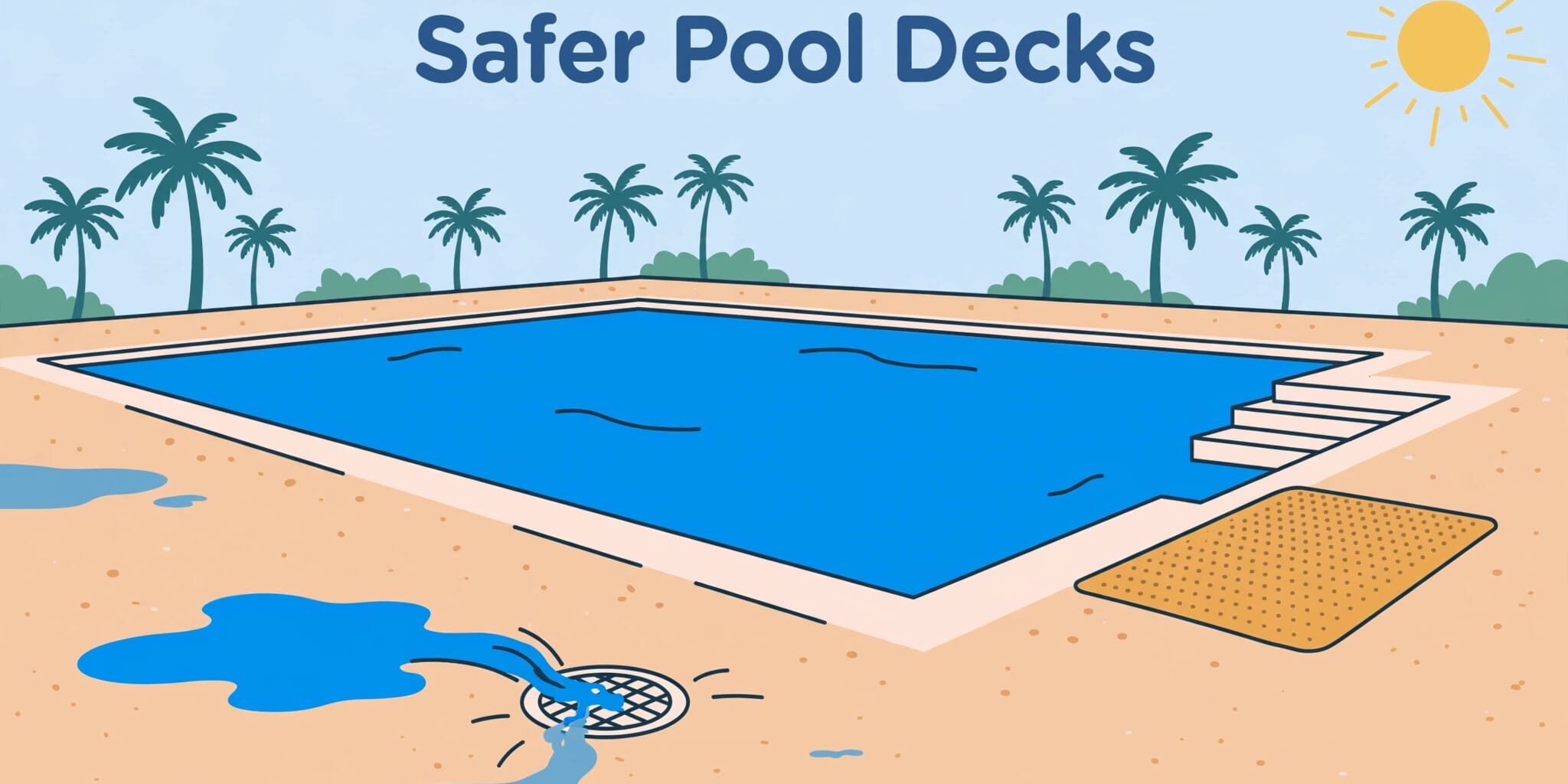
Pool deck slip prevention starts with clean surfaces, effective drainage, and finishes designed for wet feet. Southwest Florida’s rain, humidity, heat, and frequent pool use make routine upkeep important for a wet pool deck.
Sunscreen, algae, and worn sealers can make even textured decks slippery. However, the right fix depends on the cause, not the product’s promise. A careful inspection helps homeowners choose improvements that fit their deck.
Key Takeaways
- Fix standing water and damaged surfaces before adding a coating or mat.
- Choose products for their intended location, including outdoor decks, underwater steps, or small traction strips.
- Keep walking routes clear, maintain secure pool access, and continue active adult supervision.
Find Out Why the Deck Gets Slippery
Separate surface contamination from drainage problems
First, inspect the deck when nobody is swimming. Look for green growth, sunscreen residue, glossy patches, and water collecting near steps.
Algae and oily residue create a slip hazard and need cleaning. Puddles that repeatedly return to one location point toward slope or runoff problems.
Persistent ponding needs pool deck drainage repairs, rather than another layer of sealer. They also need an outlet underneath them.
Address damage before adding traction
Loose pavers, crumbling concrete, and lifted edges create trip hazards alongside slippery areas. A coating won’t restore weak concrete.
Likewise, mats can hide deterioration without fixing it. Keep people away from unstable areas until a qualified contractor assesses the damage.
Pay particular attention to coping, step edges, and deck sections around fixed deck anchors or joints. Movement or cracking there deserves prompt attention.
Choose Pool Deck Surfaces for Wet Conditions
Texture helps, but the finished surface matters
Flagstone, brick, textured concrete, and pavers can provide useful grip when finished with a slip-resistant surface for wet outdoor use. Polished stone and smooth tile can become slick.
Stamped concrete needs careful finishing, too. A glossy sealer can reduce traction even when the pattern creates a textured surface.
Compare deck materials using documented wet traction and slip resistance, not a generic “non-slip” label. Texture alone doesn’t show how a surface performs with wet feet.
Balance grip with comfort and drainage
Aggressive texture can scrape bare feet, while dark surfaces can become uncomfortable in direct Southwest Florida sun.
A suitable deck balances comfortable texture, clear runoff, and manageable transitions between materials. Raised borders and uneven expansion joints create separate hazards.
During resurfacing, contractors should preserve movement joints and keep drains open. Added material shouldn’t create lips at doorways or pool coping.
Drainage Tiles and Mats for Targeted Areas
Greatmats flexible PVC drainage tiles
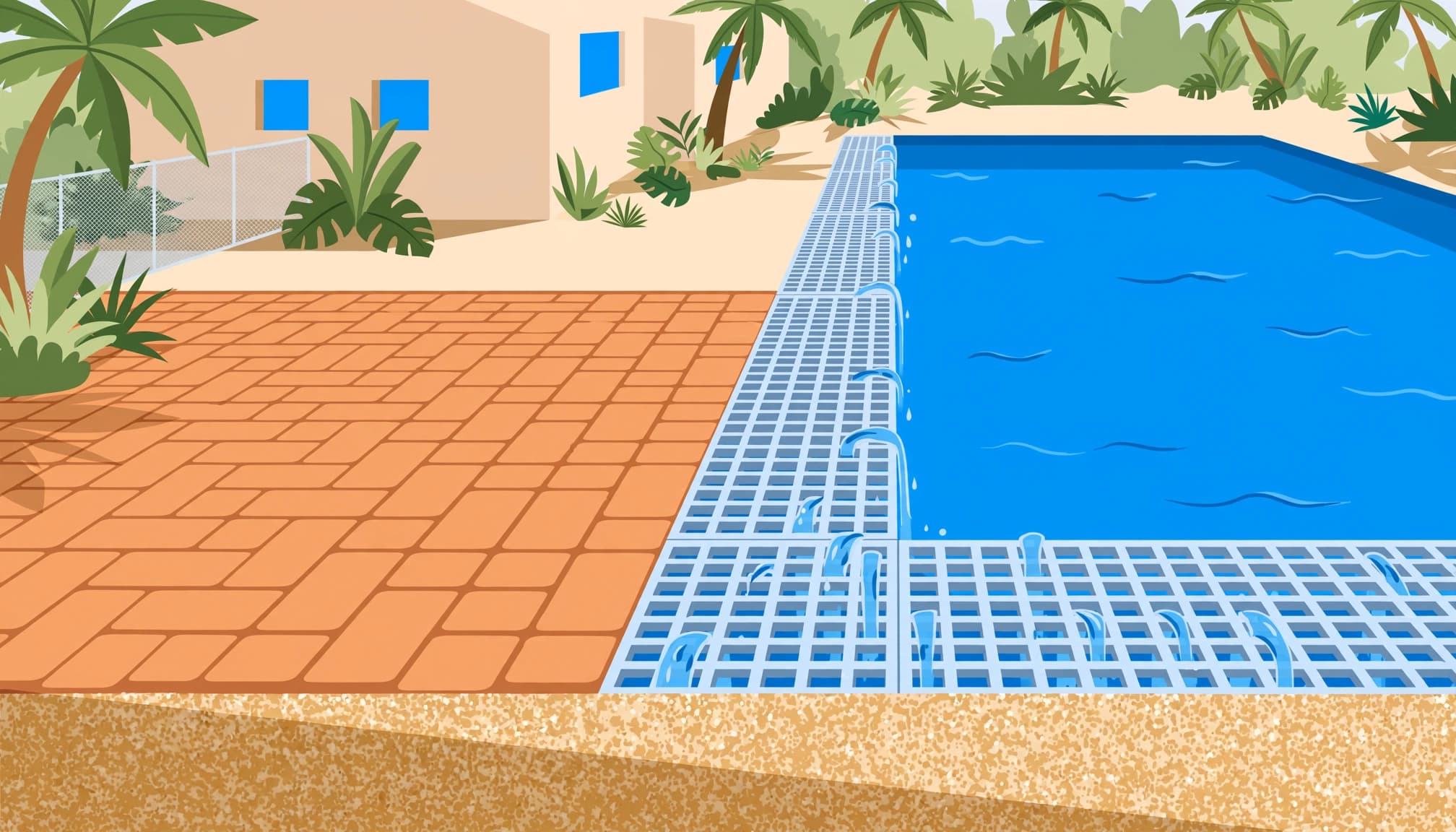
Greatmats offers flexible PVC tiles measuring 12 by 12 by 1/2 inch. Their perforated, open-grid design lets water pass through.
Loop-and-tab connections join the tiles as interlocking tiles in larger sections. They’re useful as removable pool deck mat coverage, with water flowing beneath the walking surface.
However, tiles don’t correct poor deck slope. Water still needs a clear outlet after it passes through the openings.
Edges need secure transitions, because a half-inch height change can catch a foot. Tiles shouldn’t obstruct drains or gate movement.
Closed-cell foam and closed-cell PVC resist water absorption. That helps limit moisture-related odor and mold, although pool chemicals can still damage unsuitable materials.
Main Access 200600 Smart Mat
The Main Access 200600 Smart Mat is a 36-by-36-inch weighted vinyl mat for underwater vinyl-liner pool steps.
Its purpose differs from an ordinary deck runner. Any non-slip mat used underwater must be rated for submerged use and fit a flat, appropriately sized step without overhang.
An overhanging edge can fold or catch a foot. A moving mat creates another hazard instead of dependable traction.
Homeowners should also lift mats and removable tiles periodically. Trapped moisture and grit can stain or damage the deck finish underneath.
Tread Tape and Spray for Small Slippery Areas
Jessup Safety Track 3100 tread tape
Jessup Safety Track 3100 comes in 2-inch and 4-inch widths. It provides targeted traction rather than whole-deck coverage.
Before installation, the surface must be sound, compatible, and completely dry. Rounded tape corners help reduce edge lifting.
The installer should position each strip before peeling the backing. Firm adhesion matters most around edges, where water can enter.
However, rough, crumbling concrete provides a poor bonding surface. Tape also needs an intended use compatible with barefoot contact and outdoor exposure.
Rust-Oleum AS2100 anti-slip spray
Rust-Oleum AS2100 adds texture to compatible surfaces. Multiple thin coats give better application control than one heavy coat.
Rust-Oleum’s AS2100 technical data sheet gives a 24-to-48-hour walk-on window.
Homeowners should plan at least 24 hours without light traffic. Some conditions require 48 hours or longer.
Importantly, walk-on time isn’t full durability. The manufacturer lists five to seven days for maximum durability, with cooler conditions extending drying.
A spray coating also can’t compensate for standing water or failing concrete.
Coatings and Additives for Larger Areas
SlipDoctors Deck Grip
SlipDoctors Deck Grip is a clear, slip-resistant coating for compatible concrete and other approved surfaces. It suits broader areas where isolated strips would leave gaps.
The Deck Grip application instructions recommend two thin coats, with two to four hours between coats.
Apply the second coat across the first coat’s direction for even coverage and to avoid thick, uneven patches.
Poolside applications still require suitable surface preparation. Existing sealers, moisture, and contamination can interfere with adhesion.
RTG Non-Skid Additive
RTG Non-Skid Additive mixes into the final topcoat at four ounces per gallon of compatible paint or sealer.
Mixed into a compatible topcoat, it creates a non-skid coating. It won’t repair an existing slick finish without that application.
Even distribution matters because concentrated patches can feel rough, while sparse areas offer less texture. Excessive coating thickness can also bury the aggregate.
Check that the finished system is compatible with outdoor exposure and pool chemicals, and follow the manufacturer’s instructions.
Prepare the Surface Before Coating or Tape
Surface preparation determines whether a traction upgrade stays attached. First, remove algae, mold and mildew, oily residue, and loose material with a surface-compatible cleaning method.
Next, rinse thoroughly and allow the surface to dry completely before applying tape or coatings. Concrete can retain moisture after its top looks dry.
For compatible tape locations, a final wipe with 91% isopropyl alcohol removes residue. Alcohol isn’t a universal cleaner for concrete, coatings, or vinyl.
Because alcohol is flammable, keep ignition sources away until it evaporates completely.
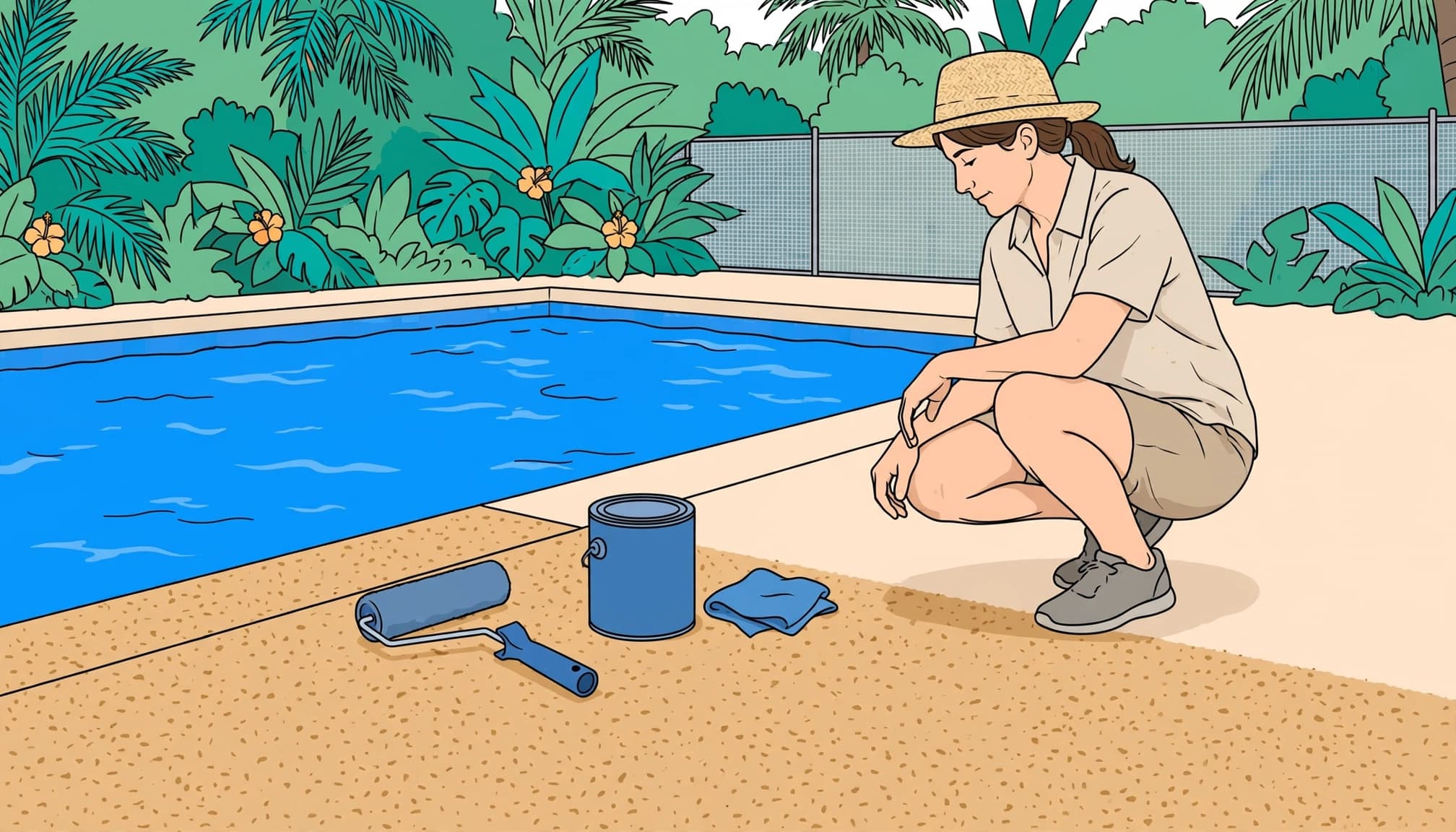
A mild application window around 60°F to 80°F can help, but individual product temperature limits take priority.
Direct sun can heat concrete well above the air temperature. Humidity and afternoon storms can also interrupt drying.
Installation needs a dry weather window that covers application and curing. Keep foot traffic away throughout that period.
A coating can feel dry before it tolerates traffic, rain, or poolside wear.
Maintain Grip Through Southwest Florida Weather
Rinse portable poolside gear with fresh water after use. Let it dry in the shade before storing it.
UV exposure degrades plastics, rubber, and foam over time. Pool chemicals also cause wear, so choose outdoor gear that’s UV resistant.
During routine cleaning, inspect tape edges, mat movement, and worn coating patches. Fix loose corners and curled edges before the next swim.
Wear well-fitting, pool-appropriate shoes, such as water shoes, around the deck. Footwear doesn’t replace drainage or regular cleaning.
After heavy rain, clear fallen debris and inspect drains. Stop swimming during thunderstorms or when lightning threatens, and supervise children near the pool.
Check lighting around steps and make sure the handrail is secure. Good visibility helps people spot wet patches, toys, and changes in deck height.
Keep furniture, planters, and pool slides out of the splash zone and walking routes. Clear paths give everyone unobstructed access around the pool.
Common Questions About Wet Pool Decks
Do anti-slip mats work in direct sun?
Suitable outdoor mats can improve traction in targeted areas. However, dark rubber can become hot, and unsuitable products may curl.
A mat needs stable placement and drainage. It shouldn’t block the gate, overlap a step, or replace repairs underneath.
Can a workout platform improve pool entry?
The Step Original supports up to 350 pounds. It has a nonslip top and rubber feet beneath the platform and risers.
However, that weight rating doesn’t establish suitability as a pool-entry step. Homeowners should use purpose-designed pool access equipment instead.
Workout equipment also needs a stable location away from splash-heavy routes.
How long does a non-slip coating last?
Service life depends on preparation, traffic, cleaning, UV exposure, and chemical contact. No single lifespan applies to every pool deck.
Wear can develop first along busy routes and near pool entries. Visible deterioration or returning slick patches call for maintenance.
A Safer Deck Starts With the Right Fix
Reliable slip prevention combines runoff control, sound surfaces, and regular cleaning. Targeted products work best when they match the cause of the slippery area.
Questions or ready to get started? Call us at (941) 500-9484