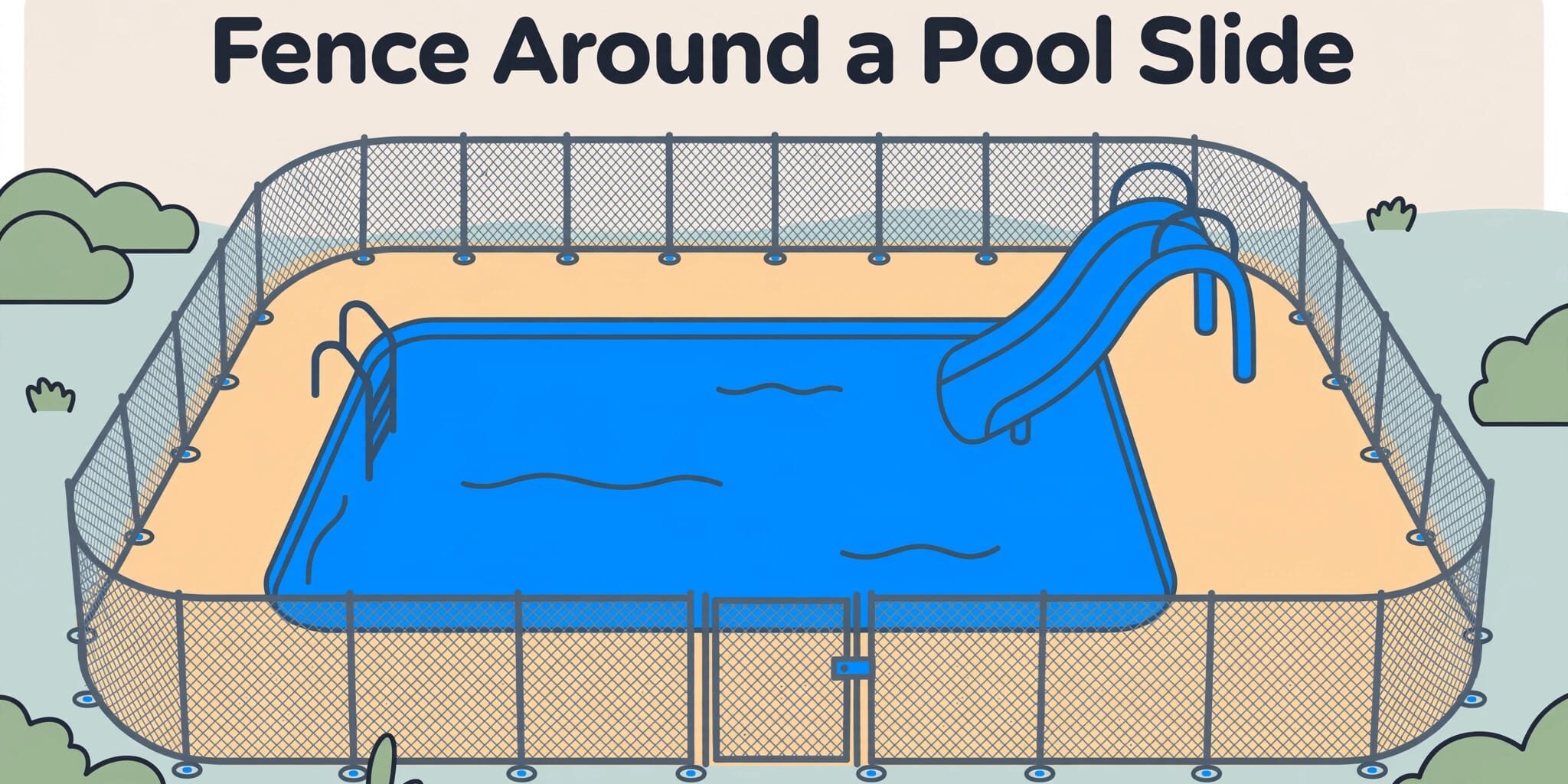
Yes, a removable pool fence with mesh can fit around a pool slide when the deck provides suitable anchoring and clearance. The safest layout keeps the entire slide, including its ladder, inside the protected pool area.
However, the complete layout matters more than the slide’s shape alone. Planning starts with the slide supports, walking space, and gate swing.
Key Takeaways
A slide doesn’t automatically rule out mesh fencing. A workable route encloses the pool and slide without leaving gaps or creating climbing shortcuts. Secure anchors and a reliable gate complete the barrier.
Plan the Fence Around the Whole Slide
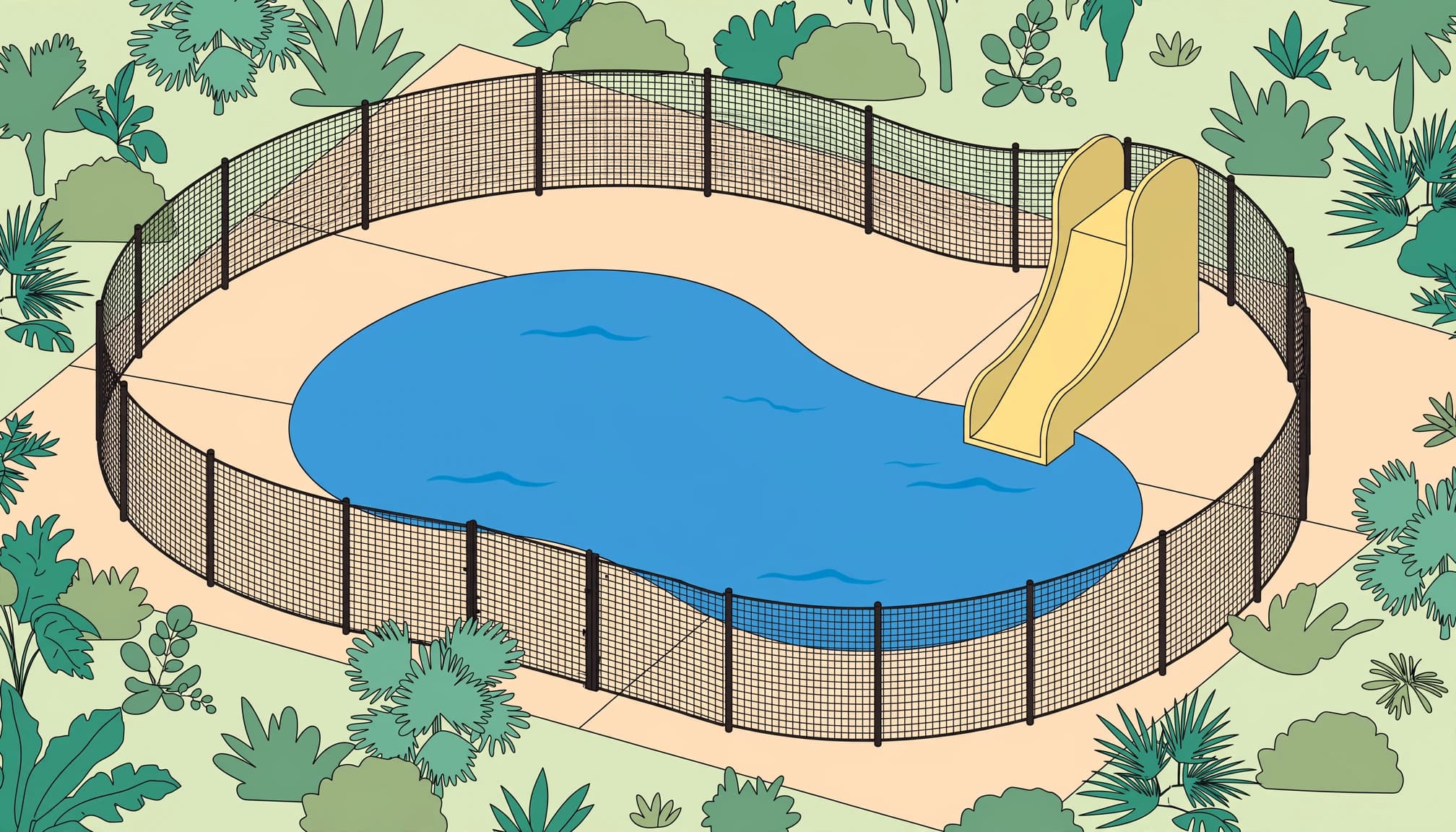
Keep the ladder inside the barrier
The mesh safety fence should surround the slide and its supports as one continuous barrier. Neither the slide body nor its ladder replaces a continuous barrier.
Nearby steps and supports can also create climbing opportunities. The route needs enough separation to prevent children from using those features to cross the fence.
Follow the slide manufacturer’s operating instructions for clearances. Mesh shouldn’t obstruct the ladder, slide exit, or required movement space.
Leave room for everyday access
Installers measure the tightest deck areas, raised walls, drains, and screen tracks before marking anchors. Then, they position the gate where adults can approach comfortably.
A self-closing, self-latching gate needs a safety latch and an unobstructed swing away from the pool. Chairs and planters shouldn’t crowd that path.
A pool fence consultation helps establish a practical route before drilling.
How a Removable Mesh Pool Fence Fits Curves
Materials and section sizes
Typical systems use UV-resistant Teslin PVC mesh across high-strength aluminum or stainless-steel poles. Common heights include four and five feet, with black, brown, or green mesh.
One common section measures approximately 15 feet, with six fence poles spaced 36 inches apart. However, dimensions vary by system.
Spring-loaded hook-and-eye connectors and safety latches join the sections. Curved layouts may need shorter sections or adjusted spacing.
Sleeve-mounted systems generally occupy less deck space than weight-filled bases that require no drilling. Therefore, narrow slide-side passages often favor properly supported sleeves.
Installation, tension, and removal
Follow the selected system’s instructions rather than a generic drilling pattern.
- First, mark the full route, including slide clearances, gate openings, drains, and sound anchor locations.
- Next, install compatible deck sleeves and fit the fence sections, starting at the ends.
- Finally, adjust tension and install the gate last because surrounding fence tension affects its alignment.
Some tension systems angle pole holes away from curves. Tight radii may require farther pole seating within the manufacturer’s sleeve specifications.
Afterward, the installer checks bottom gaps and tests closing and latching repeatedly.
One demonstration reported removal in five to six minutes and reinstallation in ten to twelve minutes. Gates and tight curves can take longer.
To take down the fence, adults release tension, lift sections carefully, and cap empty deck holes against debris. Clean, dry panels need protected storage. The barrier must return before children regain pool-area access.
Code Requirements Depend on the Complete Installation
Primary barriers and permanent attachments
Poolsafe reports that many inspectors accept its 60-inch fence as a primary barrier with a minimum 54-inch latch height. That acceptance isn’t universal.
Its Los Angeles approvals illustrate the difference. City and County of Los Angeles building departments accepted the system after L brackets secured each pole base. Those brackets made the fence non-removable.
Some city inspectors instead require epoxy securing poles within deck sleeves.
Poolsafe also recommends at least five feet between fencing and water. Closer placements may require a continuous bonding wire connected at each pole base.
However, five feet isn’t a universal setback for every Florida installation. A qualified installer and electrician should address property-specific clearance and bonding requirements.
Standards and secondary protection
ASTM Standard F-2286 addresses barrier design and performance. Many jurisdictions use ASTM F2286 as a benchmark, but the standard doesn’t replace local requirements.
Poolsafe states that its fence meets F2286 and qualifies as a 48-inch secondary barrier without L brackets.
California’s Swimming Pool Safety Act requires two qualifying drowning-prevention features for covered new or remodeled residential pools. Options include qualifying fencing, door alarms, pool alarms, and a pool cover. The qualifying features depend on the applicable law.
These California examples don’t establish Southwest Florida approval. Fence height alone doesn’t establish compliance either.
Compare Kit Prices With Complete Installation
These kit examples cover different lengths and exclude a custom slide-side layout.
| DIY kit size | Example price |
|---|---|
| 4 feet high, 48 feet long | About $190 |
| 4 feet high, 72 feet long | About $285 to $310 |
These undated examples aren’t current quotes. Gates, labor, reinforcement, and custom sections can increase the total.
Pool Fence Express costs $895 for up to three sections and 45 linear feet with standard setup. Custom slide layouts may require different pricing.
Homeowners can Get a FREE Quote for a pool safety fence.
Frequently Asked Questions
Can mesh pass underneath the slide?
Routing underneath can leave openings or put the slide within climbing reach. Enclosing the entire slide generally creates a clearer boundary.
Can homeowners install the fence themselves?
A simple layout on sound concrete may suit a DIY approach. However, tight curves, pavers, slopes, and slide supports warrant professional assessment.
Does transparent mesh replace supervision?
No. Visibility helps caregivers see the pool, but fencing supports adult supervision rather than replacing it.
A Slide-Friendly Fence Starts With a Complete Boundary
A removable mesh fence can accommodate a pool slide when the route protects the entire pool area. The strongest layout combines continuous protection with usable walking space and dependable gate operation.
Careful planning keeps the slide accessible during supervised swimming without leaving an open route around the barrier.
Questions or ready to get started? Call us at (941) 500-9484